Monday, June 16, 2014

Frozen Musical Snow Globe

  Do you wanna build a snow globe? In summer?  Us, too!  We spent a few days making the polymer clay Olaf and finding a fishbowl and sheet music.  The electronics assembly was super fast.


Here is Jack helping me with the finishing touches:

For the complete how to, visit my Instructable "Musical Snow Globe"

Friday, June 6, 2014

SD Card Reader bit - a work in progress

Today I'm taking apart Jack's broken MP3 Player so that I can harvest the SD card reader.  I am trying to make an SD card reader bit for my DIY littleBits collection.  Unfortunately, I fixed it, so now I'm not sure where to go next... 

Sunday, June 1, 2014

Arduino Jukebox - Ice Cream Theme

This is a video of me doing a teardown of my Ice Cream Jukebox, which was a project originally posted by Dave over at littleBits.  I don't have access to a laser cutter, so I used these items from my recycling bin: ice cream box, a VHS tape for the "card reader", cereal box, tape, and a speaker from broken headphones that my mom had asked me to fix.  For the different transparencies, I used a milk jug, foil lined tea bag envelope, a cut up and taped down VHS tape, and maybe I'll use a juice pouch for another transparency.

Since I used an ice cream box as the container, I thought it would be fun to use ice cream themed songs.  The songs are "It's A Small World", "The Entertainer", "Mr. Softee", and "You Are My Sunshine".  The code uses the pitches.h arduino library.

Automatic Soap Dispenser

This is a prototype in progress.  I have managed to get the circuit working correctly, but making a motor actually pump soap is challenging my skills.

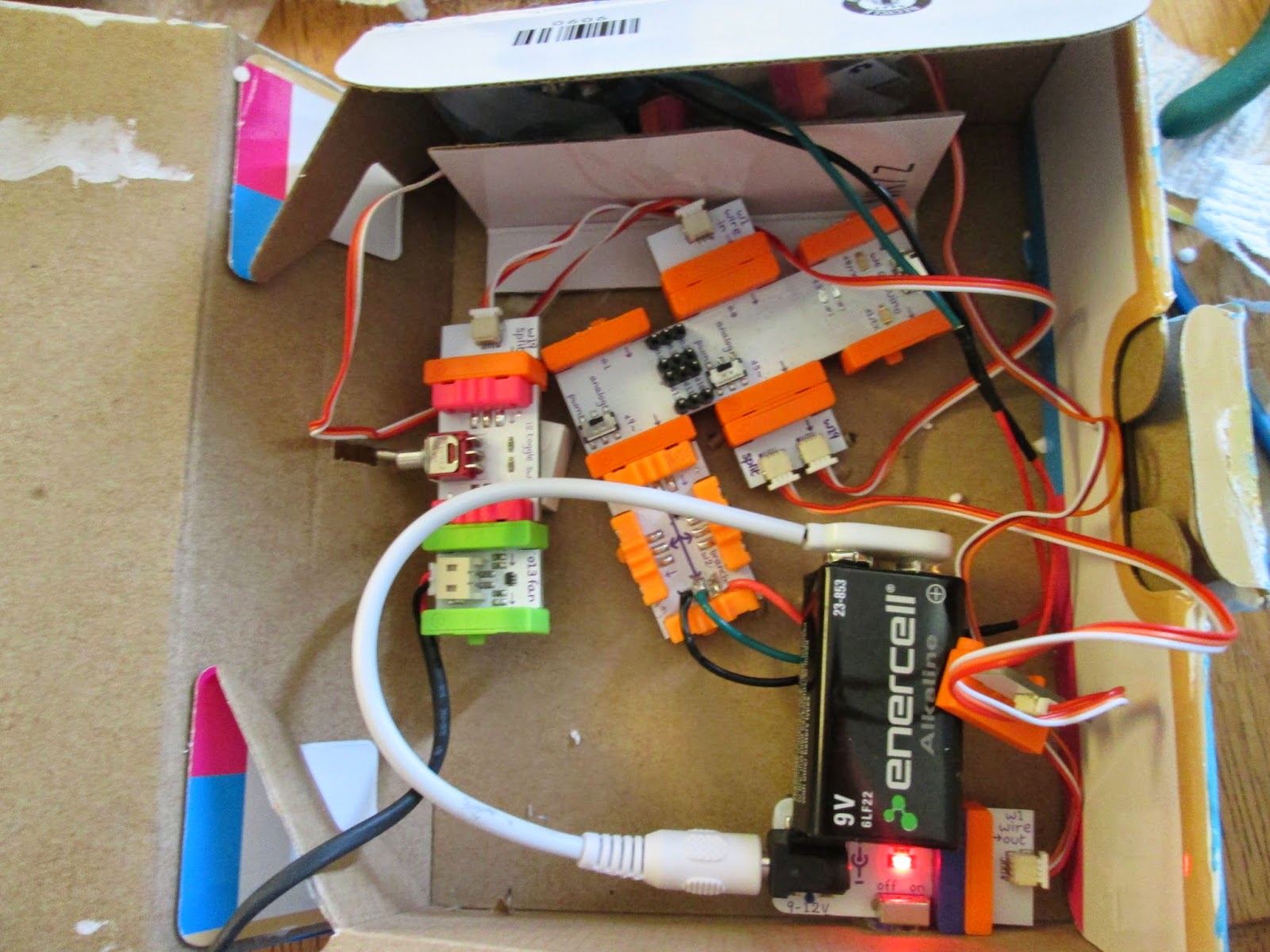
This circuit is based on expired circuit US4989755 A, which was invented by Shiau Guey Chuan.  It has been modified by JackANDJude for prototyping with littleBits.  First, with the roller switch already depressed, the user places a hand in front of the sensor.  The light trigger senses a change in light and turns on the motor.  The motor turns the gears and cam, releasing the roller switch and moving the plunger up and down.  Finally, if the user has moved away from the sensor, the cam re-presses the roller switch, thus turning off the motor and "resetting" the bistable flip flop circuit. 


The littleBits shown in this video include "double AND" and "inverter", which are my substitutes for NAND.  Unfortunately, the legos cannot push my soap dispenser even when I adjust the gears for more torque or use a dollar store dispenser with water in it.  The legos strain and break apart.  I need to come up with a design beyond the circuit.  Any ideas on solving this pumping problem would be appreciated.  :)


For reference, here is an image of the originally patented circuit:

Animation with Arduino

Animated Jumping Grasshopper!

After the "blink" sketch, this was my first arduino project.  I used the littleBits Arduino module to make 6 led's blink in sequence, which I think is a great way to animate a museum display or diorama.

I have been thinking a lot about how animals, dinosaurs, people, and bugs move.  In particular, I wanted to find out how a grasshopper jumps, so I found a great slow motion video that shows just that.  I included a clip of it here in my project video:

Paint Light Bots

Use motors and led's to make autonomous art bots that paint with light.  A camera that has a slow shutter speed or an app that can imitate slow shutter speeds plus a steady way to mount your camera is required (I actually set my ipad on the table). 


Ball Wacker with littleBits

You too can wack a foil ball or a dark balloon with a servo and a light sensor.
  1. Assemble the littleBits circuit: power + wire + wire + light sensor + servo.
  2. Attach the circuit to a lightweight stick like a chop stick or a bubble wand. The light sensor should be affixed to the end of the bubble wand so that it is facing the light. The servo should be oriented so that when the stick moves, the front of the light sensor is hitting the ball.
  3. Tape wires to the stick, leaving slack at the base to allow for movement.
  4. Set servo to turn mode and light sensor for dark mode. Adjust sensitivity so that with one light source your sensor can detect the shadow cast by either a dark balloon or a foil ball.
  5. Hold the black rectangular portion of the servo with one hand and dangle a foil ball tied to a 2 foot string with the other hand. The servo should show some movement.
  6. Hot glue a 9 volt battery clip or maybe an extra large binder clip to a block of wood so that the servo and stick have free range of movement when the servo is clipped into place.